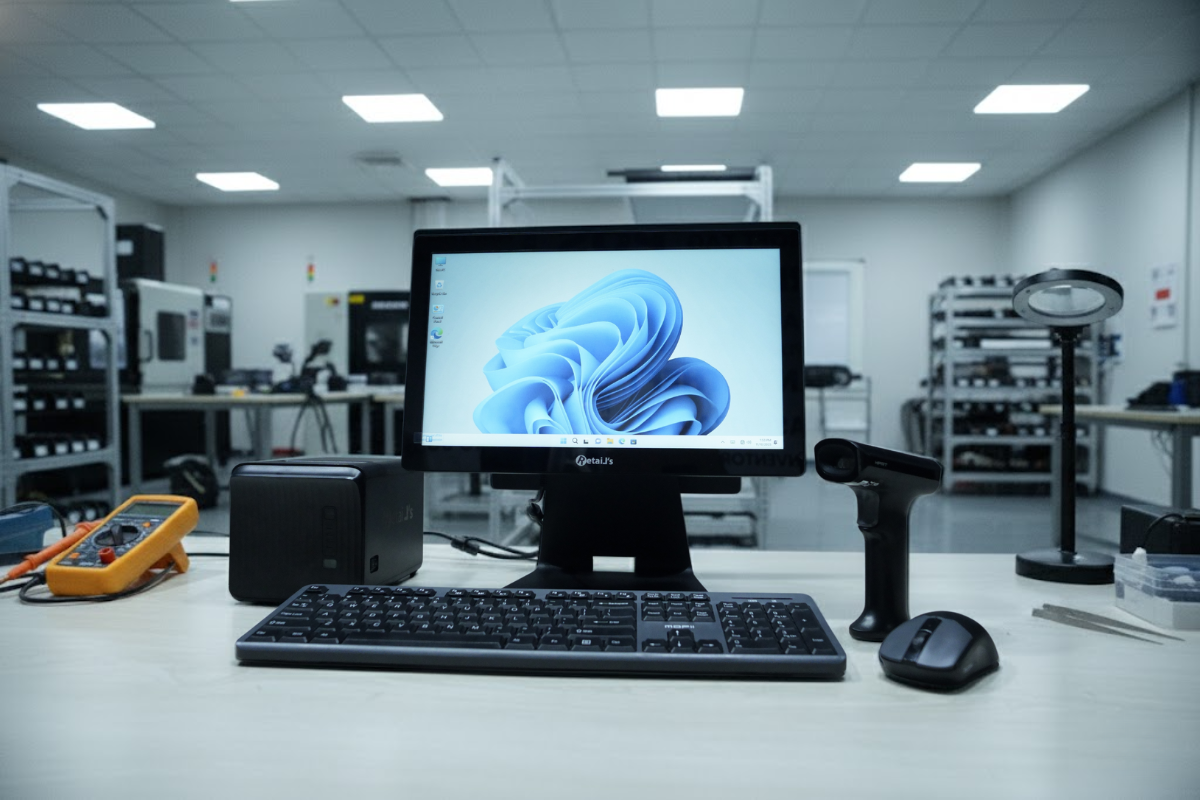

Why Most Global POS Printers Are Manufactured in China
In the fast-moving world of modern retail, the Point-of-Sale (POS) printer is the unsung hero of the checkout counter. Whether it is a busy supermarket or a high-end boutique, the ability to generate a crisp, accurate receipt in seconds is vital for customer trust and operational efficiency. When IT decision-makers and procurement managers audit their hardware, they often notice a common thread: their POS printers—even those from world-renowned brands—are manufactured in China.
This concentration of manufacturing is not accidental. It is the result of decades of infrastructure development, specialized labor clusters, and a strong electronics ecosystem. Understanding why China dominates global POS printer manufacturing helps retail owners make more informed sourcing decisions, moving past outdated stigmas to focus on what truly matters: performance and accuracy.
1. The Power of the Manufacturing Ecosystem
The primary reason China remains the “world’s factory” for POS printers is its unmatched manufacturing ecosystem. In cities like Shenzhen and Xiamen, the entire POS printer supply chain is compact into a single geographic area.
Component Availability and Integration
A POS printer is a complex assembly of thermal heads, precision gears, motherboards, and sensors. In China’s specialized industrial clusters, a manufacturer can source every single sub-component within a few kilometers of their assembly line. This proximity allows for:
- Rapid Prototyping: New designs can be tested and refined in days rather than months.
- Reduced Logistics Delays: There is no need to wait for overseas shipments of critical parts like semiconductors or specialized plastic housings.
- JIT (Just-In-Time) Production: Manufacturers can scale production up or down instantly based on global demand.
Skilled Labor and Specialization
Unlike general manufacturing, electronics require a workforce skilled in precision soldering, mechanical calibration, and firmware integration. Over the last thirty years, China has developed a massive pool of technical talent specifically trained in electronics assembly, ensuring that even high-volume production maintains a high level of technical accuracy.
2. Breaking the Misconception: Quality vs. Origin
One of the most significant shifts in the last decade is the separate of “manufacturing location” from “quality level.” Today, some of the world’s most premium retail hardware is engineered and built in Chinese facilities.
International Certifications and Standards
Reputable Chinese manufacturers operate under the same exact global standards as any Western facility. When sourcing a retail hardware manufacturing partner, professional distributors look for several key certifications:
- ISO 9001: Ensures consistent quality management systems.
- CE & FCC: Verifies that the hardware meets safety and electromagnetic compatibility standards for Europe and North America.
- RoHS: Guarantees the product is free from hazardous substances, a critical factor for environmentally conscious businesses.
Rigorous Testing Protocols
High-end POS printers undergo “stress tests” that simulate years of use in harsh retail environments. These include salt spray tests for coastal regions, vibration tests for transport, and “million-cut” tests for the automatic paper cutters. These processes ensure that the hardware can handle the high-volume requirements of a busy retail floor without failing.
3. Cost Efficiency Through Economies of Scale
It is a mistake to frame Chinese manufacturing as merely “cheap.” Instead, it should be viewed as “cost effective.” Because China produces the majority of the world’s printers, the “cost per unit” is significantly lower due to massive economies of scale.
- Bulk Sourcing: Manufacturers can negotiate better prices for raw materials like steel and high-grade plastics.
- Amortized R&D: The cost of developing new thermal printing technology is spread across millions of units, making advanced features (like 300mm/s print speeds or cloud-printing capabilities) affordable for small and medium enterprises.
4. Why This Matters for Retailers in Developing Markets
For a retail business in a growing economy like Bangladesh, the dominance of Chinese manufacturing offers several practical advantages:
Uptime and Spare Parts Availability
When a printer breaks down, every minute of downtime is a lost transaction. Because the global supply chain is centered in China, spare parts like thermal heads, rollers, and power adapters are standardized and widely available. This ensures that local service centers can repair devices quickly without waiting for expensive, proprietary parts from Europe or Japan.
Long-Term Authenticity
The iterative nature of Chinese manufacturing means that “Version 5” of a printer has likely solved all the minor bugs found in previous versions. This constant refinement results in hardware that is remarkably stable, even when subjected to the fluctuating power grids or dusty environments often found in emerging markets.
5. Navigating the Market: How to Choose the Right Hardware
While the manufacturing ecosystem is robust, not all factories are equal. The difference between a “good” printer and a “great” one often lies in the quality control (QC) standards of the brand and their local distribution partner.
A Practical Checklist for Procurement Managers:
- Verify the OEM: Does the brand have its own factory or a direct relationship with a verified manufacturer?
- Check Local Support: Does the distributor offer a local warranty and a stock of spare parts?
- Confirm Compatibility: Does the printer support standard ESC/POS commands and integrate with your specific POS software?
- Look for “Tier 1” Components: Ensure the printer uses high-quality thermal heads (often sourced from top Japanese or Chinese specialized providers) to ensure print longevity.
6. The Role of the Sourcing Partner
In markets like Bangladesh, the bridge between the factory and the retail floor is the distributor. A knowledgeable sourcing partner like Retail’s Brand does more than just move boxes. They act as the final layer of quality assurance, vetting manufacturers, testing firmware for local language support (such as English or any script), and ensuring that the hardware meets the specific thermal and electrical requirements of the region.
Conclusion: Quality is a Process, Not a Geography
The global shift toward Chinese POS printer manufacturing is a testament to the country’s evolution into a high-tech industrial leader. For the modern retailer, the focus should no longer be on where a product is made, but rather how it is made and who stands behind it.
By choosing hardware from manufacturers that adhere to international standards and partnering with trusted local distributors, business owners can equip their stores with world-class technology that balances cost-efficiency with uncompromising reliability. In the end, a printer’s value is measured by the receipts it prints and the uptime it maintains—qualities that the Chinese manufacturing ecosystem is uniquely positioned to deliver
Our Recent News

What Retailers Should Expect from POS Hardware in 2026
How Retail Hardware Ensures Brand Compatibility Longevity
Retail Automation Trends Powered by Asian Manufacturing