
Latest News
What Retailers Should Expect from POS Hardware in 2026
For decades, Point of Sale (POS) hardware was viewed as a static utility—a solid box designed to calculate totals and open a cash drawer. However, as we approach 2026, that definition is being fundamentally rewritten. The convergence of unified commerce, rising labor costs and aggressive sustainability mandates is forcing hardware to evolve from simple transaction points into intelligent, self-monitoring hubs of retail operations.
For retail business owners, IT managers, and procurement heads, the hardware landscape of 2026 will not be defined by who has the fastest processor or the sleekest screen. Instead, it will be defined by interoperability, intelligence and resilience. This shift represents a move away from buying “devices” and toward investing in “infrastructure.”
Here is what retailers should expect—and demand—from their POS hardware partners in the coming year.
POS Hardware Will Be Designed for Ecosystems, Not Standalone Devices
By 2026, the era of the “siloed” POS terminal is effectively over. In the past, retailers often struggled with compatibility issues—barcode scanners that didn’t talk to inventory tablets, or receipt printers that required complex driver workarounds to function with new payment terminals.
The expectation for 2026 is native interoperability. Hardware is being engineered to function as part of a fluid ecosystem where data flows seamlessly between the checkout counter, the mobile handheld used for inventory, and the customer-facing display. Retailers will no longer tolerate hardware that acts as a bottleneck to their software platforms.
We are seeing a shift toward “hub” architectures where the main POS terminal acts as a central server for peripherals, using standardized connectivity (USB-C, powered Ethernet) to eliminate cable clutter and compatibility headaches. This ecosystem thinking ensures that as you scale—adding more lanes or integrating new payment methods—your hardware stack expands rather than needing to be replaced.
Durability Will Matter More Than Feature Lists
While consumer technology continues to chase the thinnest, lightest designs, retail hardware is moving in the opposite direction: purpose-built resilience.
Retail environments are hostile to electronics. Greasy food truck counters, dusty warehouse floors, and humid outdoor pop-up shops destroy consumer-grade tablets and generic PCs. By 2026, the primary metric for hardware ROI will not be its initial price tag, but its Mean Time Between Failures (MTBF).
Retailers should expect hardware with higher Ingress Protection (IP) ratings becoming standard—IP54 or IP65 for protection against dust and water sprays will be the baseline, not a premium add-on. We are also seeing a resurgence in fanless designs. By removing cooling fans—the most common point of mechanical failure—manufacturers are creating sealed units that are virtually immune to the dust and debris that plague busy retail environments.
Smart procurement teams are already realizing that a device with a 5-year lifecycle that survives a coffee spill is infinitely cheaper than a budget device that requires replacement every 18 months.
Smart Automation Will Be Embedded at the Hardware Level
Perhaps the most significant leap for 2026 is the introduction of hardware-level intelligence. Historically, if a POS terminal was overheating or a battery was failing, the retailer only found out when the device shut down mid-transaction.
Future-ready hardware now incorporates self-diagnostic sensors and embedded telemetry.
- Smart Batteries: Instead of a simple percentage indicator, modern POS batteries use Battery Management Systems (BMS) to report their “State of Health” (SoH) to IT managers. You will know months in advance which units are degrading and need replacement before they fail during a holiday rush.
- Predictive Maintenance: Terminals will monitor their own internal temperatures, storage health, and peripheral connectivity. If a printer’s print head is nearing the end of its life, the hardware will trigger an alert to your support team automatically.
This shifts IT support from a reactive “break-fix” model to a proactive “predict-prevent” model, drastically reducing downtime.
Energy Efficiency and Sustainability Will Become Expected Standards
Sustainability is no longer just a corporate social responsibility (CSR) slide; it is a regulatory and operational imperative. With the EU and other global markets tightening regulations on electronic waste and energy consumption (such as the Right to Repair movement and Eco-design directives), POS hardware in 2026 must be greener.
Retailers should expect:
- Lower Power Consumption: Processors that deliver high performance with a fraction of the wattage, reducing the electricity bill for chains with hundreds of locations.
- Modular Repairability: The “glued-shut” design philosophy is fading. Retailers will demand hardware that allows for easy component swapping—replacing a screen or a battery without discarding the entire unit.
- Recycled Materials: Casings made from post-consumer recycled plastics and packaging that eliminates Styrofoam in favor of biodegradable materials.
This shift isn’t just about saving the planet; it’s about saving money. Longer lifecycles and lower energy costs directly improve the bottom line.
Global Manufacturing with Strong Local Adaptation
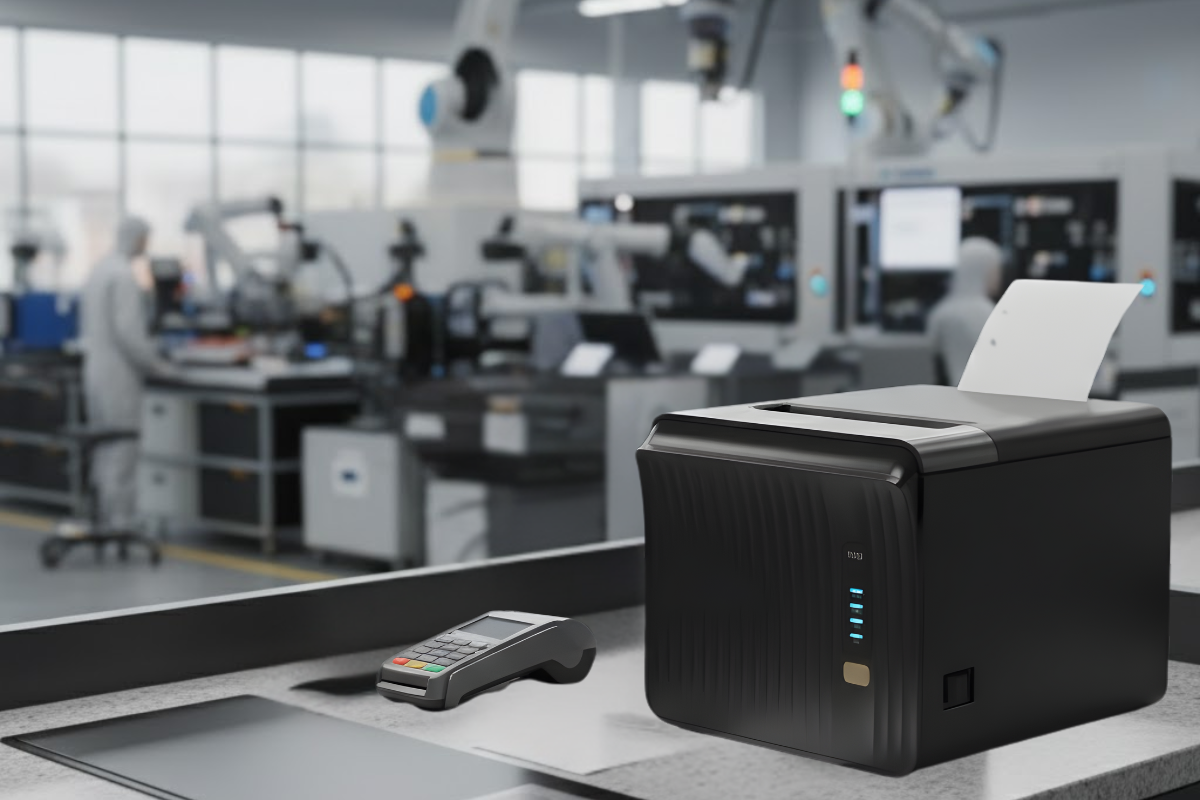
A common misconception in the industry has been that “Asian manufacturing” implies lower quality. By 2026, this myth will be entirely dispelled. Regions like Taiwan have cemented their position not just as assemblers, but as the world’s primary innovators in IoT and ruggedized computing. The R&D coming out of these hubs is producing some of the most reliable, high-performance hardware on the market.
However, the hardware origin is only half the story. The differentiator for 2026 is local adaptation. Retailers need global manufacturing precision paired with regional expertise. This means hardware that is physically manufactured in high-tech Asian hubs but is firmware-tuned, certified, and supported by local teams who understand the specific tax laws, payment certifications, and language requirements of the market.
Companies like Retail’s Brand effectively bridge this gap, ensuring that retailers benefit from the economies of scale and engineering excellence of global manufacturing while retaining the security of local accountability and support.
Security, Compliance, and Certification Will Be Non-Negotiable
As payment fraud becomes more sophisticated, hardware security is tightening. In 2026, “compliance” goes beyond just the payment terminal; it extends to the entire POS register.
We are seeing a move toward Trusted Platform Modules (TPM) becoming standard in POS motherboards, ensuring that the hardware has not been tampered with. Secure Boot protocols prevent unauthorized software from loading when the device starts.
Furthermore, compliance with global standards—CE, FCC, RoHS, and the evolving PCI DSS 4.0 requirements—is non-negotiable. Retailers must ensure their hardware vendors are not just compliant today but have a roadmap to stay compliant as standards evolve. Using non-certified hardware is no longer a cost-saving measure; it is an unacceptable liability risk.
Retailers Will Expect Long-Term Support, Not One-Time Hardware Sales
Finally, the transactional relationship between hardware vendor and retailer is evolving into a lifecycle partnership. In the fast-moving world of consumer tech, a 3-year-old phone is obsolete. In retail, a 3-year-old POS terminal is just getting started.
Retailers in 2026 will prioritize vendors who offer:
- Long-Term Availability: The assurance that the exact same model (or a fully compatible successor) will be available for purchase 3 to 5 years from now to maintain fleet consistency.
- Guaranteed Spare Parts: Availability of screens, power supplies, and batteries long after the warranty period ends.
- Firmware Updates: Ongoing security patches that protect the hardware from new vulnerabilities.
The “Total Cost of Ownership” (TCO) calculation will heavily weigh these support factors. A cheaper upfront device that becomes unsupportable in two years is a bad investment compared to a slightly more expensive unit with five years of guaranteed support.
Conclusion: Strategic Hardware Choices Will Define Retail Success
As we look toward 2026, the message is clear: POS hardware is no longer a commodity. It is the physical backbone of the unified commerce experience.
Retailers who view hardware procurement as a strategic initiative—focusing on durability, ecosystem compatibility, and intelligence—will build operations that are more resilient, efficient, and profitable. Those who continue to chase the lowest upfront cost will likely find themselves cycling through failing equipment and fighting compatibility fires.
The future of retail is smart, sustainable, and built to last. Your hardware should be too.
Our Recent News
How Retail Hardware Ensures Brand Compatibility Longevity
Retail Automation Trends Powered by Asian Manufacturing
Inside a POS Hardware Factory: Quality Control That Matters