

Latest News
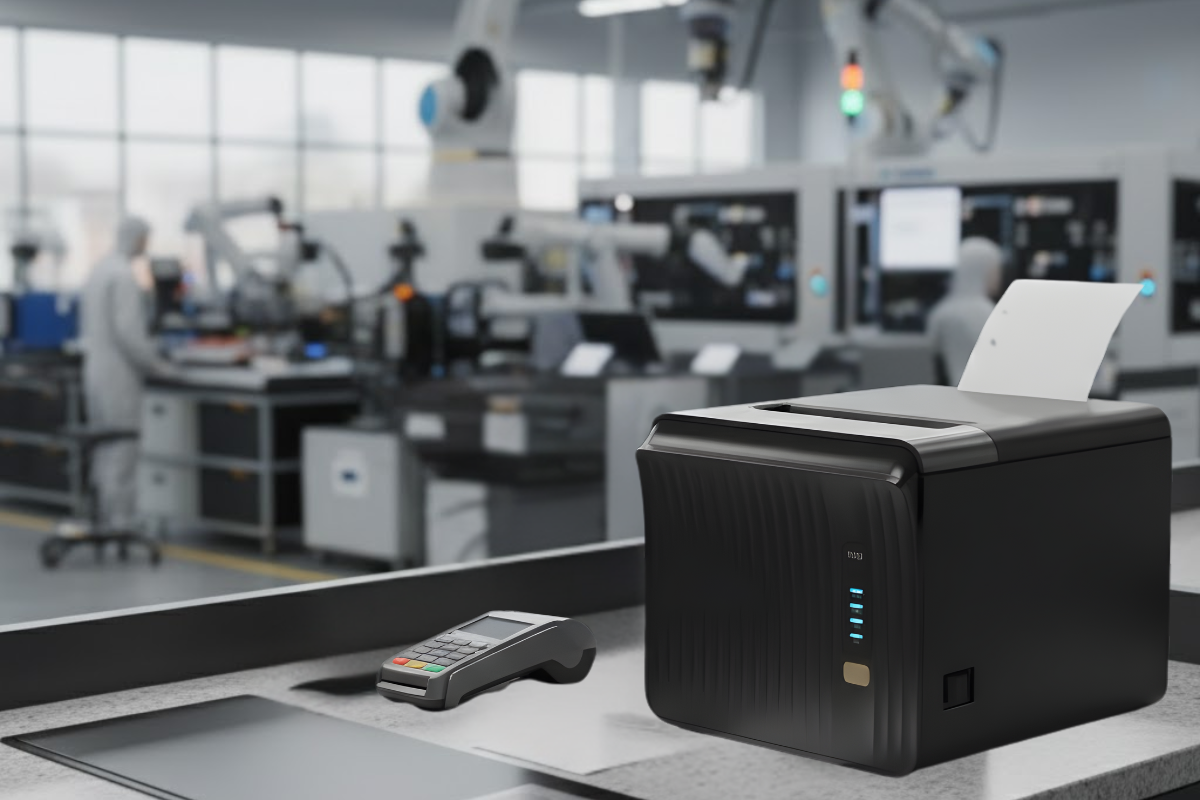
Inside a POS Hardware Factory: Quality Control That Matters
In the world of modern commerce, the Point of Sale (POS) system is the heartbeat of the operation. Whether it is a high-volume supermarket, a boutique clothing store, or a bustling restaurant, the moment a POS printer jams or a terminal freezes, business stops. Revenue is lost, customer queues grow, and the reputation of the brand is tarnished.
For retail business owners and IT managers, choosing POS hardware often feels like a gamble between high-priced “global brands” and more affordable alternatives. However, the true indicator of performance is not the logo on the plastic casing or the country of origin. Instead, it is the invisible, rigorous process of POS hardware factory quality control that occurs long before the device reaches your counter.
This article takes you inside a modern POS manufacturing facility to reveal the testing protocols and engineering disciplines that ensure business continuity.
Why Quality Control is Non-Negotiable in Retail
POS hardware is not consumer electronics. Unlike a personal tablet or a home printer used occasionally, a POS terminal or thermal printer must operate for 10 to 14 hours a day, often in environments that are less than ideal. In emerging markets, these devices face additional challenges: fluctuating power voltages, high humidity, and dust.
If a POS device lacks rigorous retail hardware quality testing, the “hidden costs” of ownership—maintenance, downtime, and lost sales—quickly exceed the initial purchase price. Quality control is the only shield a business owner has against these operational failures.
The Manufacturing Workflow: More Than Just Assembly
A world-class POS hardware manufacturing process is a synchronized flow of logistics and engineering. It begins long before the assembly line starts moving.
- Component Sourcing: Selecting stable suppliers for internal parts.
- Incoming Material Inspection (IMI): Verifying the “DNA” of every component.
- Sub-Assembly: Building the internal cores (PCBs, motors).
- Main Assembly: The integration of the housing, screens, and peripherals.
- In-Process Quality Control (IPQC): Testing at every stage of the build.
- Final Quality Control (FQC): Stress testing the finished product.
Incoming Material Inspection (IMI): The First Quality Gate
The reliability of a POS printer or terminal is dictated by its weakest component. This is why the IMI phase is the most critical stage of the process.
- Thermal Print Heads: In printers, the print head is the most expensive and vital part. Factories must test for heating consistency and ceramic durability to ensure the head won’t burn out after a few months of heavy use.
- Motors and Gears: The mechanical motor that drives the paper must be tested for torque and heat resistance.
- Motherboards (PCBs): Every PCB undergoes an automated optical inspection (AOI) to look for soldering defects that could cause short circuits later in the device’s life.
- Capacitors and Connectors: Quality factories source capacitors that can handle the heat generated by continuous operation, preventing the “swelling” that leads to hardware failure.
By filtering out substandard parts at the door, the factory ensures that the final product has a foundation of excellence.
Assembly-Level Quality Control: Precision in Motion
As the POS device moves down the assembly line, human expertise meets automated precision.
Soldering and Connectivity
One of the most common causes of POS failure is a loose connection. During assembly, technicians inspect every solder point. Modern factories use specialized testing jigs to ensure that USB, Serial, and Ethernet ports can withstand thousands of “plug-and-unplug” cycles without losing connectivity.
Firmware Validation
Before the casing is sealed, the device’s “brain”—its firmware—is loaded and validated. This ensures the hardware communicates perfectly with the operating system. This is where compatibility testing begins, ensuring the device can handle different languages, character sets, and command protocols (such as ESC/POS).
The “Torture Room”: Functional and Stress Testing
A finished POS device might look perfect, but its true resilience is only revealed under duress. This phase of POS device reliability testing is what separates professional-grade hardware from hobbyist electronics.
1. Life-Cycle Testing (The Cutter and Print Head)
For thermal printers, the “Auto-Cutter” is a frequent point of failure. A high-quality factory will take sample units and run them through 1.5 million to 2 million cuts. If the blade dulls or jams before the threshold, the entire batch is re-evaluated.
2. Heat and Humidity Simulation
In markets like Bangladesh, where humidity can exceed 80%, hardware must be “climatized.” Units are placed in environmental chambers that simulate extreme heat and moisture to ensure the internal electronics don’t corrode or overheat.
3. Vibration and Drop Tests
Retail environments are physical. A printer might be bumped; a terminal might be moved. Vibration tables simulate the rigors of shipping, while drop tests ensure the internal frame can protect the delicate electronics from a standard counter-height fall.
4. Continuous Print Stress
Factories often run “black-out” tests where a printer generates continuous rolls of text and graphics for hours. This identifies if the power supply or the thermal head will overheat under the pressure of a “Friday night rush” at a busy retail outlet.
Understanding International Standards (ISO, CE, FCC, RoHS)
When reviewing POS hardware, you will often see a series of acronyms. These aren’t just marketing labels; they represent specific manufacturing disciplines:
- ISO 9001: This confirms the factory follows a consistent Quality Management System. It means they have a process for fixing mistakes when they happen.
- CE & FCC: these certifications ensure the device doesn’t emit dangerous electromagnetic interference that could mess with your Wi-Fi or other store electronics.
- RoHS: This guarantees the hardware is free from hazardous materials like lead and cadmium, which is essential for environmental safety and worker health.
Traceability and Final Inspection
The final stage of quality control is accountability. Every high-quality POS device is assigned a unique serial number that is tied to its specific production batch.
If a merchant in the field reports a specific issue, the factory can use that serial number to “look back” and see which batch of components was used, which technician was on the line, and what the testing results were on that day. This level of POS hardware manufacturing process traceability is what allows for effective after-sales support and continuous product improvement.
The Final Quality Layer: The Role of the Local Distributor
Even the best factory in the world cannot account for every local variable. This is where the partnership with a responsible local distributor—like Retail’s Brand—becomes the final “quality gate.”
A dedicated local partner provides:
- Power Stability Testing: Ensuring the devices can handle the specific voltage fluctuations of the local power grid.
- Software Compatibility: Verifying that the hardware works seamlessly with local accounting and ERP software.
- Local Buffer Stock: Providing immediate replacements so that a “factory issue” never becomes a “store closure.”
- Expert Sourcing: Identifying which factories actually follow the protocols mentioned above, rather than just choosing the lowest-cost provider.
Conclusion: Engineering Trust Through Process
Reliable POS hardware is never an accident. It is the result of a disciplined, multi-stage engineering process that prioritizes longevity over flashiness. When a business owner invests in hardware, they aren’t just buying a printer or a screen; they are buying the peace of mind that their checkout line will never stop moving.
The next time you evaluate a POS device, look past the brand name. Ask about the IMI protocols. Ask about the cutter’s life cycle. Ask about the local support structure.
In the demanding world of retail, quality isn’t something that can be assumed—it must be engineered. By choosing hardware backed by rigorous factory quality control and supported by a knowledgeable local partner, you ensure that your technology remains an asset to your growth, rather than a liability to your operations.
Our Recent News

What Retailers Should Expect from POS Hardware in 2026
How Retail Hardware Ensures Brand Compatibility Longevity
Retail Automation Trends Powered by Asian Manufacturing